
Welcome to Camberley Brazilian Jiu Jitsu, Est March 2022 with Black belt Antony Walker. An initiative set up to provide and deliver affordable training to the local community & support to our veterans of all emergency services.
Camberley Jiu Jitsu
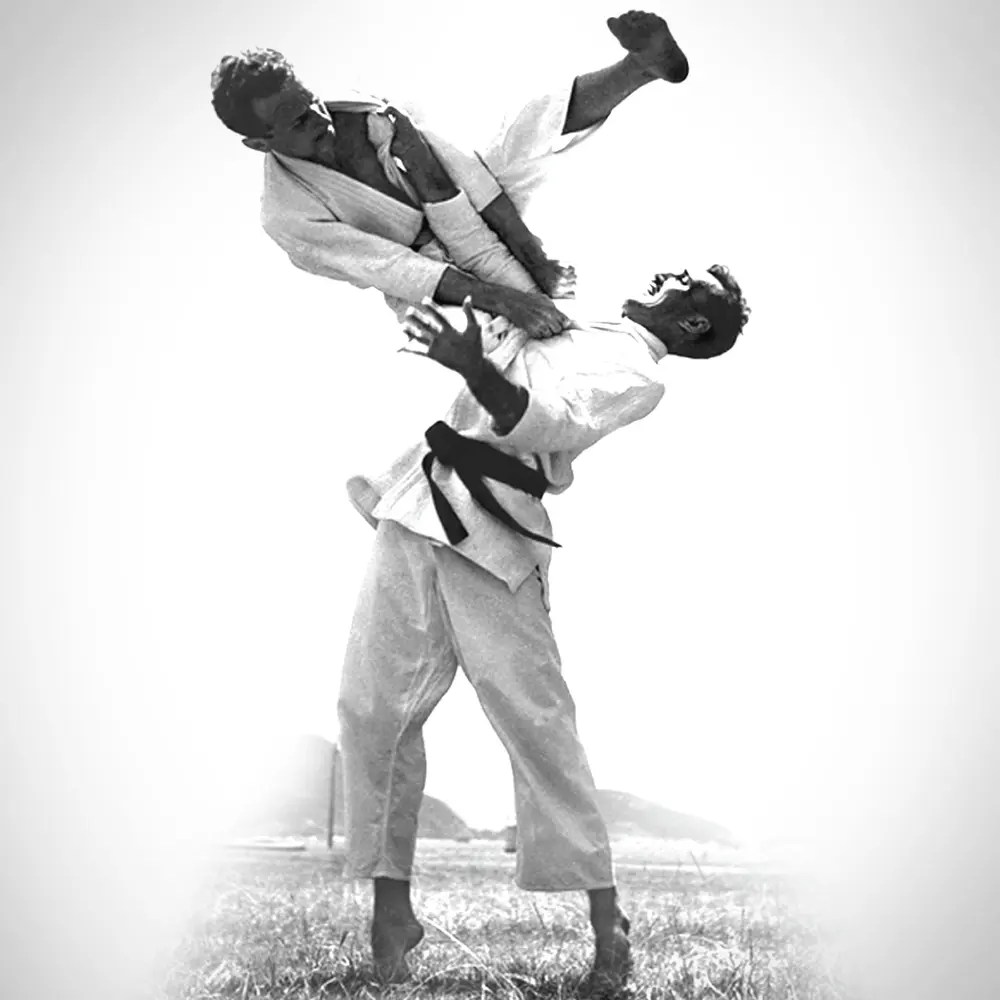
A short history of Brazilian Jiu Jitsu
At the beginning of the 1900s, Mitsuyo Maeda, a pupil of Jigoro Kano, was sent to Brazil to promote and teach Judo and Jiu Jitsu. On his arrival in Brazil, he was welcomed and supported by a politician named Gastão Gracie. In thanks for the help he received to establish himself in Brazil, Mitsuyo Maeda taught Jiu Jitsu to Carlos and Hélio, Gastão’s two sons. Hélio, being particularly small, quickly understood that by applying certain concepts, floor-based combat allowed him to greatly reduce the impact of a difference in size between two adversaries. Together with his brother Carlos, he developed a system using the floor-based techniques and guarding himself by positioning his legs between himself and his adversary.
Carlos and Hélio had several sons who were all trained in Brazilian Jiu Jitsu. Several of them took on challenges to prove the effectiveness of Brazilian Jiu Jitsu through multiple mixed martial arts combats. Following the Gracie’s victories through these events, Brazilian Jiu Jitsu took off and has now developed into a world-famous sport in its own right.
What is Brazilian Jiu Jitsu
Brazilian Jiu-Jitsu (BJJ) is a grappling-based martial art whose central theme is the skill of controlling a resisting opponent in ways that force him to submit. Due to the fact that control is generally easier on the ground than in a standing position, much of the technique of Brazilian Jiu-Jitsu (BJJ) is centred around the skill of taking an opponent down to the ground and wrestling for dominant control positions from where the opponent can be rendered harmless.
To control and overcome greater size, strength, and aggression with lesser size and strength is the keynote of the sport. This is done by utilising superior leverage, grip, and position upon your opponent. Students of the sport gain a deep understanding of the workings and limits of the human body.
This knowledge can be used to subdue and control an opponent with whatever level of severity the student chooses. The path to this knowledge is physically and mentally demanding. Students benefit from greatly increased physical fitness, problem-solving ability, self-knowledge of their body and mind and the many social benefits of working within a large group of like-minded fellow students as you learn and have fun together.
Many students first learn about Jiu-Jitsu through the great popularity of mixed martial arts (MMA) competition, where Brazilian Jiu-Jitsu technique is very prominent.
Indeed, the beginnings of the contemporary MMA competition were largely tied up with proving the combat-efficiency of Brazilian Jiu-Jitsu.
The practice of Brazilian Jiu-Jitsu as a sport, however, is strongly separated from MMA. Daily classes do not feature kicking or punching. The focus is on a safe grappling technique that can be done on a daily basis with no more fear of injury than any other contact sport. More importantly Bjj is more than just a workout, Brazilian Jiu Jitsu is often referred to as “human chess” in that it exercises both the body and the mind as well as applying the technique.
 Camberley Brazilian Jiu Jitsu